School of thought · from 1948
Social market economy and ordoliberalism
Free markets within a strong regulatory framework, with social balance.
The social market economy is the economic model of the Federal Republic of Germany and is now even written into the EU treaties. Its theoretical core is ordoliberalism: the state should not steer the economy, but set a firm framework in which competition works. Anyone in Germany who talks about mergers, subsidies, industrial policy or bank bailouts is arguing, often without knowing it, for or against this school.
01How the idea emerged
The Weimar Republic was known as the “land of cartels”. Companies agreed on prices and quantities, and economic power and political influence merged. Under National Socialism this turned into a centrally directed war economy. A group of economists and lawyers in Freiburg drew their own lesson from this: neither unbridled laissez-faire nor a planned economy protects freedom. Both lead to a concentration of power.
From the 1930s, the Freiburg School around the economist Walter Eucken and the lawyers Franz Böhm and Hans Großmann-Doerth developed the alternative model. The state should be strong, but only in one place: as guardian of the competitive order. It sets the rules, ensures stable money and prevents cartels and monopolies. It does not intervene in prices and production decisions themselves.
Alfred Müller-Armack coined the term “social market economy” (Soziale Marktwirtschaft) in 1947. He added social balance to the competitive order: the market creates prosperity, and the state ensures that as many people as possible share in it.
Ludwig Erhard put it through politically. As Director of Economic Administration for the western occupation zones, he lifted controls on a large share of prices with the currency reform of June 1948, against considerable resistance. Shop windows filled up overnight. In public memory, the “economic miracle” (Wirtschaftswunder) of the 1950s that followed became inseparably linked with Erhard and his book “Prosperity for All” (Wohlstand für alle, 1957).
02Timeline
- 1930s
The Freiburg School around Walter Eucken, Franz Böhm and Hans Großmann-Doerth.
- 1947
Alfred Müller-Armack coins the term “social market economy”.
- 1948
Currency reform and lifting of price controls by Ludwig Erhard.
- 1952
Eucken’s “Principles of Economic Policy” (Grundsätze der Wirtschaftspolitik) is published posthumously.
- 1957
Act against Restraints of Competition (GWB, the Cartel Act), founding of the Bundesbank, the dynamic pension.
- 1958
The Federal Cartel Office (Bundeskartellamt) begins its work.
- 1973
Merger control is introduced in Germany.
- 1990
The State Treaty on Monetary, Economic and Social Union establishes the social market economy for reunified Germany.
- 2009
The Treaty of Lisbon names the “social market economy” as a goal of the EU.
- 2019
The EU blocks the merger of Siemens and Alstom, sparking a debate about European champions.
03How it works
The most important distinction is between rule-setting policy (Ordnungspolitik) and process policy (Prozesspolitik). Rule-setting policy sets the rules of the game: property rights, freedom of contract, liability, the ban on cartels, an independent central bank. Process policy intervenes in the ongoing course of the economy: subsidies for individual firms, price controls, stimulus programmes. Ordoliberals want as much rule-setting policy and as little process policy as possible.
Eucken formulated constituent principles for this: a functioning price system at the core, stable money, open markets, private property, freedom of contract, liability and a reliable economic policy that does not keep changing. In addition there are regulating principles, such as monopoly control and correcting cases in which market prices do not reflect the true costs, as with environmental damage.
Particularly influential is the liability principle: whoever takes the profit should also bear the loss. And the idea that competition is not only efficient but limits power. Franz Böhm described competition, in essence, as the most effective means of curbing economic power. This explains the strong position of competition law in Germany.
The “social” part was renegotiated again and again in practice. Erhard wanted to achieve social progress mainly through growth and competition, and was sceptical about expanding the welfare state, for example the pension reform of 1957. Later governments expanded the welfare state considerably. The dispute over how much “social” belongs to the market economy remains unresolved to this day.
04Key terms you must be able to explain
- Rule-setting policy (Ordnungspolitik)
Shaping the rules within which companies decide freely. The counterpart to process policy, which intervenes in individual processes.
- Liability principle
Whoever decides and receives the profit also bears the risk of loss. It is violated when losses are regularly shifted onto the state.
- Competitive order
A legally secured framework that prohibits cartels, controls mergers and limits market power.
- Subsidiarity
The smaller unit regulates what it can regulate itself. The state only steps in when individuals, families or local authorities are overwhelmed.
- Ministerial authorisation (Ministererlaubnis)
The Federal Minister for Economic Affairs can still allow a merger blocked by the Federal Cartel Office on public interest grounds. Rarely used and always controversial.
05Variants and later developments
- Freiburg ordoliberalism
A strict competitive order, with as little intervention in processes as possible. Its influence continues today in competition law and in the Bundesbank tradition.
- Sociological liberalism
Wilhelm Röpke and Alexander Rüstow also emphasised the social preconditions of the market: the Mittelstand, community, limiting the rise of mass society.
- Eco-social market economy
An extension to include ecological goals: environmental costs should feed into market decisions through prices such as the CO₂ price, rather than through individual regulations.
06Critique and opposing views
- Market liberals
The term “social” is so elastic that almost any intervention can be justified under it. Hayek considered the word “social” misleading in this context.
- The left and the trade unions
The framework does not prevent growing inequality in wealth and income. Without strong redistribution and co-determination, “prosperity for all” remains a promise.
- Advocates of industrial policy
Pure competition policy is not enough against state-backed competitors from China and subsidy-heavy US programmes. Europe needs bigger champions and targeted support.
- Practice since 2008
Bank bailouts, company aid during the pandemic and billions in subsidies for chip factories contradict the liability principle and restraint in process policy.
07Practical examples
- 1948Lifting of price controls
With the currency reform, Erhard freed many prices, even though the occupation authorities and large parts of the political establishment were sceptical. Production picked up quickly, and the black market largely disappeared.
- 2016Edeka and Kaiser’s Tengelmann
The Federal Cartel Office blocked the takeover, and Economics Minister Sigmar Gabriel granted a ministerial authorisation with conditions to preserve jobs. Lawsuits and a fierce debate about economic order followed.
- 2019Siemens and Alstom
The European Commission blocked the rail merger because of excessive market power in Europe. Germany and France then called for more room for European champions, an open conflict between competition policy and industrial policy.
Politicians who stood for it
- Ludwig ErhardGerman Federal Minister of Economics 1949–1963, Federal Chancellor 1963–1966
Lifting of price controls with the 1948 currency reform, Cartel Act 1957
08What this means for you as a consultant
- 01
Think M&A with competition law in mind. For every deal, check market definition, market shares and possible remedies early. A synergy case that relies on pricing power is a risk for clearance.
- 02
Assess subsidies properly. Grants are not a gift but a contract with conditions, clawback risks and political dependency. Run the case without the funding as well.
- 03
Rules instead of micromanagement. The same logic applies to group management: the holding company sets rules, targets and capital allocation, and the business units decide. If you steer every process centrally, you lose speed and accountability.
- 04
Build liability into incentive systems. Whoever is responsible for profits must also feel the losses. Bonuses without malus and budgets without consequences violate the liability principle on a small scale.
+Further reading
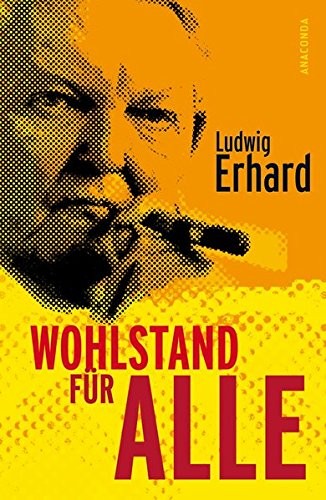
Wohlstand für alle
Ludwig Erhard · 1957
Erhard’s account of the social market economy: competition as the path to prosperity for broad sections of society.
09Frequently asked questions
What is the social market economy in simple terms?
An economic model in which companies and consumers make free decisions in markets, but the state protects competition, ensures stable money and provides social balance.
What is ordoliberalism?
The Freiburg School around Walter Eucken. It calls for a strong state that enforces a competitive order but does not intervene in individual market processes.
What is the difference between rule-setting policy and process policy?
Rule-setting policy (Ordnungspolitik) sets the rules, such as competition law and property rights. Process policy (Prozesspolitik) intervenes directly in processes, for example through subsidies for individual firms or price controls.
Who invented the social market economy?
Alfred Müller-Armack coined the term in 1947. Ludwig Erhard put it into political practice, drawing on the ideas of the Freiburg School around Walter Eucken.
Is the social market economy written into the German Basic Law?
No, the Basic Law (Grundgesetz) does not explicitly lay down an economic model. But the term appears in the 1990 State Treaty on German unification and in the EU treaty.
+More schools of thought
Last updated: 25 November 2026. Carefully researched, but without guarantee. Not legal, tax or investment advice. Disclaimer