Applying
The case interview, step by step
What is tested, which cases come up, which structures help and where most applicants fall down.
- 5steps
- 6case types
- 5typical mistakes
In shortIn a case interview you solve a business problem live. What is tested is not your knowledge but how you think: structure, numbers, judgement and clear communication. The answer comes first, the reasoning afterwards.
The process in five steps
- (01)Understand
Repeat the question, clarify the objective, pin down terms and time frame. Two or three targeted questions, not ten.
- (02)Structure
Build a MECE structure, explain it out loud and link it to an initial hypothesis. This is where the case is decided.
- (03)Analyse
Run the numbers, read the charts, put every finding into context straight away: what does it mean for the hypothesis?
- (04)Summarise
Summarise interim results regularly and say which branch comes next.
- (05)Recommend
Answer first, then two or three reasons, then risks and next steps. Just as you would in front of the board.
The six most common case types
With a typical question and the structure that usually works.
- Market sizing
“How many e-bikes are sold in Germany each year?”
Top-down or bottom-up, segmentation
- Profitability
“Our profit has fallen by 20 per cent. Why?”
Profit tree: revenue (price × volume) minus costs (fixed, variable)
- Market entry
“Should our client enter the Polish market?”
Market, competition, own capabilities, economics, mode of entry
- M&A
“Should our client acquire competitor X?”
Market, target, synergies, price, integration
- Pricing
“How should we price our new product?”
Costs, competition, willingness to pay
- Growth
“How do we double revenue in five years?”
Ansoff matrix: existing and new products and markets
Example: market sizing
“How many coffee-to-go cups are used in Germany each year?”
- Population84 m
- of whom regularly drink coffee on the go (assumption)× 30 %
- cups per person per week (assumption)× 2
- weeks per year× 52
- Result≈ 2.6 bn
The assumptions are deliberately rough. In the interview, what counts is that you state them openly and check them for plausibility. For comparison: Deutsche Umwelthilfe (Environmental Action Germany) puts the figure at around 2.8 billion disposable cups a year. A good close would be: “Around 2.5 to 3 billion. The biggest lever in my estimate is the share of regular users.”
Where most applicants fall down
- Forcing a memorised framework onto every question instead of building a structure that fits this particular case.
- Calculating in silence for too long. The interviewer wants to hear how you think.
- Stating numbers without context. Every number needs the sentence “This means …”.
- Summarising everything at the end but not giving a recommendation.
- Ignoring the interviewer’s hints. If they ask a follow-up question, it is almost always a nudge.
Books for your preparation
- Case trainingCase in PointMarc P. CosentinoThe standard book on case studies, with many practice cases.View on Amazon
- Case trainingCase Interview SecretsVictor ChengA former consultant’s view of what interviewers really test.View on Amazon
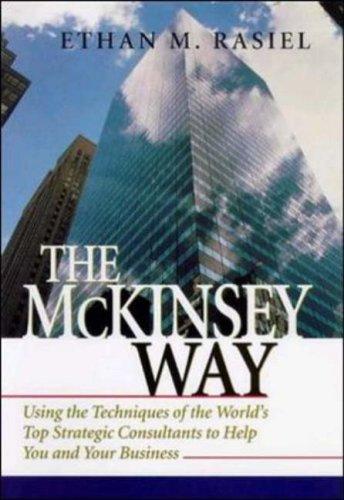
The McKinsey Way
Ethan M. Rasiel · 1999
How top strategy consultants solve problems: hypothesis-driven, fact-based and MECE.
The Pyramid Principle
Barbara Minto · 1978
The standard work on structured writing in consulting: answer first, reasoning second.

Frequently asked questions
What is a case interview?
A job interview in which you solve a business problem live, usually in 20 to 40 minutes. It tests structure, numeracy, judgement and communication, not industry knowledge.
How do I prepare for a case interview?
Learn the basic structures (profitability, market entry, market sizing), practise mental maths and work through at least 20 to 30 cases out loud with a partner. Read “Case in Point” and “The Pyramid Principle” alongside.
Do I need to memorise frameworks?
Know them, yes; apply them by rote, no. Interviewers notice immediately when a standard structure does not fit the question. Better: build your own structure for the case from basic building blocks.
How long does preparation take?
Most successful applicants practise for four to eight weeks, with several cases a week. What matters is the number of cases solved out loud, not the number of pages read.
Last updated: 25 November 2026. Carefully researched, but without guarantee. Not legal, tax or investment advice. Disclaimer